Est. 2009
Provenance
A collection is only as good as its records. Ours go back to 2009 without a gap, and everything on this page is something we will show you rather than assert.
The premise
Two founders, one standard
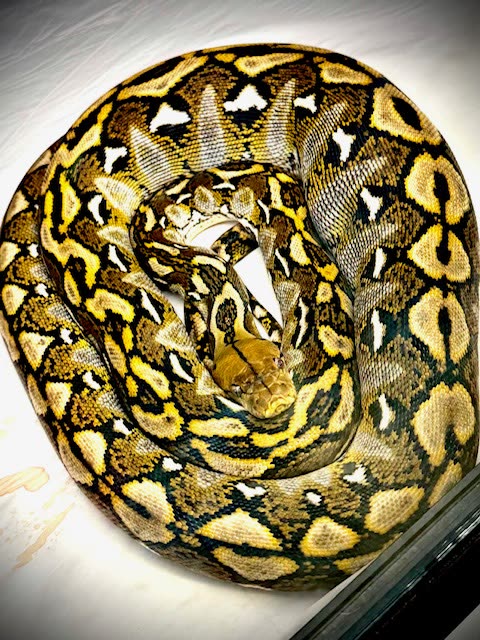
The collection today is Knox and Knyx. Starting with two animals gives us no excuse for a vague record: each founder can be followed individually through feeding, sheds, weights, condition and behaviour before a pairing is ever considered.
Spring 2027 is the anticipated offspring window, not an inventory forecast. Maturity, condition and compatibility decide whether the pairing moves forward, and a date on a page does not outrank any of them.
No animal is currently available. If offspring arrive, placement begins only after they are established and documented; interest recorded beforehand is not a deposit or a promise of an animal.
The facility
How the room actually runs
Nothing here is unusual. It is simply done consistently, which turns out to be the hard part.
Every enclosure on two thermostats
A proportional thermostat driving the heat source, and an independent over-temperature cut-off behind it set four degrees higher. A single thermostat failure at ninety degrees destroys a room in under four hours. We have had two failures in seventeen years. Both were caught by the second device.
Weights logged, not remembered
Every animal is weighed on a fixed schedule and the figure is written down. A weight series is the earliest diagnostic you have for almost everything that goes wrong, and it is worthless if it lives in your memory. Those series transfer with the animal.
Ninety-day quarantine, without exception
Every intake, including animals from breeders we have known for a decade. A positive mite finding restarts the clock at day zero. We publish the full protocol as a tool because there is no reason to keep it to ourselves.
Nothing is power-fed
Growth curves are deliberately unremarkable. Pushing an animal to breeding weight in half the natural time measurably shortens its life, and it produces females that fail at their first clutch. We would rather sell you a slower animal in two years.
Photographs at every shed
Colour in this hobby is a moving target — a blood python is a different animal in March and September. The photographic series is how you judge what a gene is actually doing rather than what one lucky frame suggests.
Lineage recorded to the founder
Not a certificate generated the morning of despatch. A continuous record, with both parents photographed, clutch data attached, and every generation back to the animal we originally acquired. Available for inspection before you commit to anything.
Position
What we will not work with
The Spider / Champagne / Hidden Gene Woma locus. Every animal carrying any of these three alleles has a neurological syndrome, ranging from a mild head tilt to corkscrewing severe enough that the animal cannot strike accurately at prey. No homozygous form has ever been produced alive, in nearly three decades. This is not disputed by anyone breeding them; what is disputed is whether it matters.
We think it matters, and we do not breed, buy, broker or place them. The Gene Lab will still calculate pairings involving them, because withholding the arithmetic helps nobody.
Jaguar carpet pythons. Same problem, same reasoning. The homozygous form is not viable and the heterozygous form carries a variable wobble.
Super forms of the Cinnamon and Black Pastel locus. Elevated rates of vertebral kinking and duckbill. We work with both genes in single copy and screen every hatchling.
Anything on the Lacey Act injurious list that we cannot place responsibly. No Burmese pythons, no African rock pythons, no anacondas — regardless of what somebody is willing to pay for one.
Visiting
The room is open, by appointment
Anyone spending five figures on an animal should see where it was produced. We schedule visits on weekday afternoons, we will show you the records for any animal in the building, and there is no expectation that you buy anything.